

Helping others say 'the long goodbye'
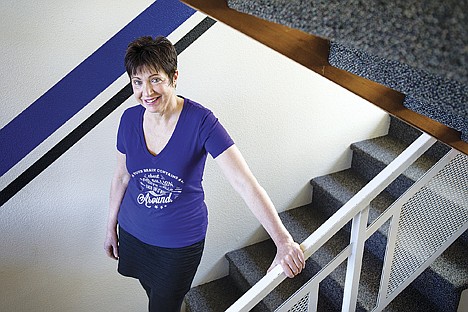
<p>P.J. Christo is the North Idaho outreach coordinator for the Alzheimer's Association's Inland Northwest Chapter.</p>
Pamphlets and purple things.
P.J. Christo's Coeur d'Alene office has a large inventory of both.
As the North Idaho outreach coordinator for the Alzheimer's Association's Inland Northwest Chapter, Christo uses the many fliers and handouts to help those dealing with the disease that claims the color purple as its own.
She spoke to The Press Tuesday about the increasing number of Alzheimer's diagnoses in the United States, and about the disease's crippling emotional and financial effects.
"The community is lucky to have this office here in Coeur d'Alene," Christo said.
Colorful, framed, original pictures done in oil pastels line the walls of Christo's small office. She smiled, explaining that the artworks were created by people living at a nursing home in Spokane.
Christo said that although she is a registered nurse, she works mainly as a social worker, making referrals, finding resources and educating the community about Alzheimer's.
A type of dementia, Alzheimer's causes problems with memory, thinking and behavior. It is a progressive disease. In its early stages, memory loss is mild, but with late-stage Alzheimer's, individuals lose the ability to carry on a conversation and respond to their environment.
For a moment, Christo became choked up as she talked about the families her agency helps. She knows there are more people out there who need the type of support the Alzheimer's Association offers.
"This is the disease to beat," Christo said, tapping her finger on the table of the small conference room. "It's the epidemic of this century."
How long have you been working with Alzheimer's patients and their families in Kootenai County?
I've been with the association for 16 years. I started out helping out with the senior companion program. The Alzheimer's Association donated time to that program for dementia families here in our community. We don't do that anymore, but that's how I started. That was a part-time job.
Then the gal who used to do what I do now, she quit, and they were concerned about what was going to happen with this office. I said I would do it for two weeks, and I'm still here. That was about 11 years ago.
What keeps you coming back to work each day?
When you realize the capacity of this disease's affect on families, it's like no other disease. I've been a nurse. I've been in hospitals. I've seen cancer. I've seen all sorts of medical problems, and this disease is the long goodbye.
This disease is so devastating to families financially. I know of nothing else where patients may need 24-hour supervision for up to 20 years. People don't usually last that long, but if you think of the cost of that, it's absolutely astronomical.
This disease is affecting so many people. When was the last time you heard a president talk about Alzheimer's and dementia? It was Obama. Whether you like Obama or not, they are realizing that this disease is really going to break the nation's back.
When you say "break the nation's back," what do you mean?
Financially. One out of every five dollars of Medicare is spent on some sort of dementia. We have around 5.2 million people with this disease here, and we will have many more throughout this century.
Why now?
Because of the baby boomers, the people who were born between '46 and '64. The silver tsunami is coming. That's just about here. The greatest risk factor for this disease is age, and we don't die when we're 65 anymore. We don't die from heart disease like we used to. We're all living, but at what cost? When they invented Social Security in the 1930s, the life span was 60.
What about the emotional cost?
It's devastating to families. Every day, every week, every month they see a little piece of their loved one float away. And it's physically draining for them. We call it the '36-hour day.'
Is this personal for you in any way?
It's personal and it's not. I have an uncle that died and when I look back upon it now, I know he that he died with some sort of dementia.
But when you work in this, and you help these families ... It's not like some diseases where they're here and they're gone. I mean, I'm hardcore. I'm a nurse. I worked in intensive care. I used to be on a code blue team. But this is the kind of thing where you see people year after year after year coming to support groups, coming to our programs. It's just amazing.
What do you consider your greatest challenge in doing this work?
The greatest challenge is that there aren't enough hours in a day to do what needs to be done. Working for a nonprofit, there are always more things to do. There are more programs to be had, there are always more people to touch, there are always more families to be helped, and we're having more and more people with this disease.
Do you think the American public is aware of this growing epidemic?
I don't really think that they are. I'd say that most people know somebody with dementia somewhere: a neighbor, a relative, a friend, somebody's mom. Almost everybody knows somebody, but until it touches you on a very personal level, you don't get it. You haven't walked in those shoes, and when you do, it's the 'aha' moment. Most people don't really get it until then.
What do families experience when caring for a loved one with this disease?
If you've seen one person with Alzheimer's, that's all you've seen, because they're all so very different. The problem is, there is no cook-book recipe. I can't tell someone that their loved one is going to experience this, this and this, and here is how we treat it ... For a lot of our people, the drugs don't even touch it. The drugs don't work for everybody.
This is the only disease in the top 10 that has no prevention, it has no cure and there are no drugs to stop it. It's the only one.
And you don't just up and die. You lose a little bit of yourself, and you wax and wane. When you wax and wane, that means that you have a great day, and that gives the family hope, and then the next three days are horrible.
So those are some of the challenges?
Not for me, but for the families. That's why we need support groups, and we have them. I've got a lunch support group, a dinner support group, and they're all free. I've got an educational support group. I've got a Saturday support group. We've got an early stage support group, which was a brand new program just this fiscal year ... for people willing to come forward in the early stages, and talk, with each other and with a counselor. We've got two wonderful counselors that work with that group. And I've also got a brand new program that we just really started in January. It's a social engagement program. Because when you have this disease, what happens is that your friends fall away. You think people that are going to be your rock, that have been with you for 20 years, are going to be your rock through everything, and suddenly...
They have many reasons. They don't know how to behave. They don't know what to expect. They're afraid themselves. They don't know how to help you. They feel helpless themselves. You can't do the same things you used to do as a caregiver, or even as a couple. So these people eventually fall away from you and your loved one. So now you have nothing, and you're isolated. It's a very isolating disease.
So we have a social engagement program so people in the early stages can come together, and we do things together. We just had a potluck last week, and we did a little thing like, where were you in '72? It was amazing. People just so totally enjoyed it.
We've been bowling together. We've got people in their 70s and 80s, and some are in their 50s.
If they couldn't bowl, they were up there cheering, and they were so adorable, and I thought, this is why we do what we do.
It sounds like you just answered my next question, which is, what are some of the joys you find in doing your work?
Yes, that is one of the joys, because you can see that they are still engaged with people. They enjoy talking with each other, and I encourage them to get together on the outside. They get each other. They understand it.
I can tell you the saddest thing. The saddest thing is when I get a memorial donation for somebody who died from Alzheimer's ... and I've never heard of them. They never contacted me. Why didn't they ever call? Why haven't they come to a support group? Yes, we need the money. We do everything on donor dollars. We don't do anything on federal funding. We're the biggest donor to research outside the feds.
But for me, when someone dies from this and I don't recognize their name, that's just frustrating. We could have helped them on their journey, because it's a long journey.
What's your advice to people dealing with Alzheimer's?
My advice is to talk about it. You know back in the 1950s, when people would talk to each other, they would whisper, "She has cancer." Now it's, "She has Alzheimer's." We don't do that with cancer anymore, and we need to stop doing it with Alzheimer's.
One in three seniors dies either with it or from it, and I think it's down now to every 68 seconds somebody is diagnosed.
When people start talking about it, then they come forward, and that's called awareness. They need to get a definitive diagnosis, and they need support. They need to talk about it.
For more information about the disease and treatment options, for care-giving tips and services available in the community, or for emotional support, contact the Alzheimer's Association's 24-hour help line, call 800-272-3900. Email assistance is also available: [email protected].