
Sending a message to Congress
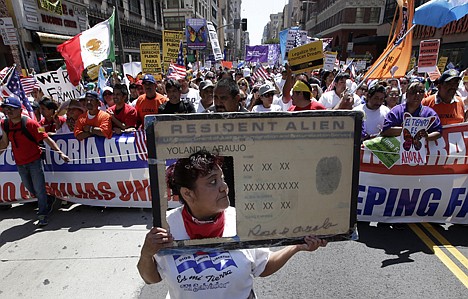
<p>Rosa Araujo, center, leads a large crowd of protesters during a May Day rally in Los Angeles, Wednesday. Demonstrators demanded an overhaul of immigration laws Wednesday in an annual, nationwide ritual that carried a special sense of urgency as Congress considers sweeping legislation that would bring many of the estimated 11 million people living in the U.S. illegally out of the shadows.</p>
LOS ANGELES (AP) - Demonstrators demanded an overhaul of immigration laws Wednesday in an annual, nationwide ritual that carried a special sense of urgency as Congress considers sweeping legislation that would bring many of the estimated 11 million people living in the U.S. illegally out of the shadows.
Thousands joined May Day rallies in dozens of cities from Concord, N.H., to Bozeman, Mont. In Salem, Ore., Gov. John Kitzhaber was cheered by about 2,000 people on the Capitol steps as he signed a bill to allow people living in Oregon without proof of legal status to obtain driver's licenses.
In Vermont, more than 1,000 people assembled on the Montpelier Statehouse lawn. And in New York, thousands of demonstrators marched in downtown Manhattan waving banners and banging on drums in a scene reminiscent of Occupy Wall Street's heyday.
The generally lively gatherings across the country were marred late Wednesday as a few dozen protesters in Seattle began pelting police with objects - possibly rocks and other items - and officers responded with pepper spray. The spat of violence came hours after a march for immigration reform by thousands of protesters had ended. The clashes were reminiscent of the gathering a year ago when some protesters broke windows and set fires.
The May Day crowds paled in comparison to the massive demonstrations of 2006 and 2007, during the last serious attempt to introduce major changes to the U.S. immigration system. Despite the large turnouts six years ago, many advocates of looser immigration laws felt they were outmaneuvered by opponents who flooded congressional offices with phone calls and faxes at the behest of conservative talk-radio hosts.
Now, immigrant advocacy groups are focusing heavily on contacting members of Congress, using social media and other technology to target specific lawmakers. Reform Immigration for America, a network of groups, claims more than 1.2 million subscribers, including recipients of text messages and Facebook followers.
Many of Wednesday's rallies featured speakers with a personal stake in the debate. Naykary Silva, a 26-year-old Mexican woman in the country illegally, joined about 200 people who marched in Denver's spring snow, hoping for legislation that would ensure medical care for her 3-year-old autistic son.
"If you want to do something, you do it no matter what," Silva said. "There's still more work to do."
Police in New York restrained several demonstrators, but the marches were peaceful.
Gabriel Villalobos, a Spanish-language talk radio host in Phoenix, said many of his callers believe it is the wrong time for marches, fearful that any unrest could sour public opinion. Those callers advocate instead for a low-key approach of calling members of Congress.
"The mood is much calmer," said Villalobos, who thinks the marches are still an important show of political force.
In Los Angeles, a band playing salsa classics from the back of a truck led a march up Broadway. Demonstrators waved American flags and signs with messages such as "Stop deportations."