

State's food-insecure number highest in nation
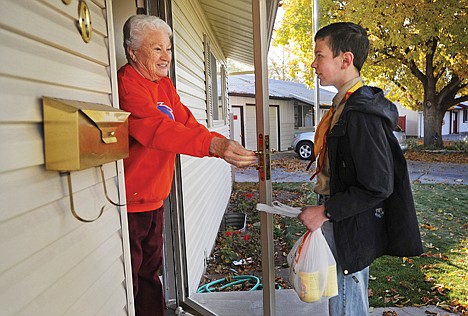
<p>Thomas Memmott, right, a Boy Scout in Troop 338, collects food from Idaho Falls resident Margaret Andrus on Oct. 19 in Idaho Falls.</p>
IDAHO FALLS - Thomas Memmott and Chris Burgett have never met.
As a 13-year-old Idaho Falls Boy Scout, and a Blackfoot woman living on a fixed income through disability, it's likely that the two never will.
But recently, Memmott and thousands of other eastern Idaho Boy Scouts took time to give back to thousands of people facing hunger every day through the annual Scouting for Food Drive. The drive helped people such as Burgett.
The need is undeniable.
For fiscal year 2012, the Idaho Foodbank's state network reported it distributed 11.4 million pounds of food (9.5 million meals), an increase of 9 percent from 2011, when the network distributed 10.6 million pounds (8.8 million meals).
There are 267,620 food-insecure individuals in Idaho. That number represents 17 percent of the population, or 1 in 6 Idahoans, the 20th highest rate in the country.
About 95,150 Idaho children (23.4 percent or nearly 1 in 4) are food insecure, the 25th highest rate in the country. Of that total, 23,008 (20.2 percent) are children younger than age 5, the 10th highest rate in the country.
Those statistics mean something to people such as Burgett. To her, they aren't only numbers. They represent her own experience.
With puffs of hot breath clinging to the cold morning air, the day started with a prayer.
Heads bowed, the group of Boy Scouts gathered at a Church of Jesus Christ of Latter-day Saints parking lot. They prayed for safe travel. For a good turnout. For the ability to help those who need help the most.
They didn't know that by the end of the day, the drive would result in more than 338,000 nonperishable food items coming through the doors of warehouses such as the Eastern Idaho Community Action Partnership. The day produced 32,000 community service hours from 11,000 individuals such as Memmott.
He was humbly hesitant to estimate how many items he's personally collected during the past five years.
"A couple of thousand items, maybe," he said. "But it's not just me. That happens all over the nation."
After the Scouts gathered at the church, they spread throughout the neighborhood, street by street. Scoutmaster Thomas Ryan, 20, offered to drive Memmott down two streets near the church. Ryan left the car idling as Scouts ran to and from the houses.
Margaret Andrus, who has lived in Idaho Falls for more than 50 years, collected canned fruit, tuna and soup for the drive. She was Memmott's first stop of the morning.
"It's important to help those in need, those who are struggling every day," she said. "I have never had to go hungry. I don't know what that's like. That's why I want to give back. It's my hope those people who get this can use it and get back on their feet."
Occasionally, folks along the street couldn't contribute, and sometimes Memmott walked away from a home with one or two cans in his slender, red-knuckled grasp. More often, like at the Andrus home, the Scout walked away with a bulging sack barely holding everything together.
It took only about 45 minutes to collect enough cans to fill Ryan's hatchback. The Scouts met again at the church parking lot, shuffling sack after sack of goods from individual cars into a moving truck ready to take the food to its next location: the Idaho Falls Elks Lodge.
Well-organized chaos was the only way to describe the Elks Lodge sorting stations as donations poured in from across the city. A handful of local troops gathered there on the morning of the drive as their way to contribute.
Boy Scout Committee Chairman Dave Shaw was on hand to oversee the sorting of the food by Scout Troops 387, 382, 301 and 6.
"Service to others is what this is all about," he said. "They're learning that doing something that you're not getting paid for can be something you can feel really good about ... if you do good things for others, other good things come back to you."
A line of trucks, with Boy Scouts dropping off hundreds of sacks of food, systematically came and went through the gravel parking lot like a well-oiled assembly line.
As the sacks were dropped off, Scouts and their families sorted more than 14,000 individual nonperishable food items into about a dozen categories at this location alone.
Canned fruit, baby food and stew were quickly ushered to their rightful tables and corresponding boxes, along with soups, canned milk and vegetables. Shaw said there still was plenty of work to be done after the cans left the sorting station.
Bags of food stacked nearly to the ceiling resembled lava dripping down from a volcano the morning of Oct. 19 at the Eastern Idaho Community Action Partnership's warehouse. The partnership stores U.S. Department of Agriculture commodities, as well as donated food. It distributes food - monthly and weekly - to 13 different pantries throughout eastern Idaho.
At least another week of sorting and stacking of the 338,000 items was required before they made their way to drivers such as Burnell Walker.
Walker, a retired Bonneville County deputy sheriff, volunteers through the partnership. He had his truck idling as early outside of the Community Action Partnership warehouse.
Two and a half pallets of food - holding about 5,250 food items - made up the bulk of Walker's weekly delivery to the Idaho Falls Community Food Bank. When he arrived, volunteers rushed to unload the cargo.
At the Idaho Falls food bank, an individual requesting food fills out a slip of paper each time he or she collects a box. Income eligibility for an individual requesting a food box is less than $1,273 a month. For a family a four, the income level is less than $2,610.
But the food collected by the Boy Scouts is far-reaching for residents, traveling to places such as Salmon, Challis and Blackfoot.
Fibromyalgia, a syndrome that saddles a person with long-term, bodywide pain, often leaves Burgett tired and sore. It also inhibits her ability to hold a full-time job.
Looking for a place that gives assistance, she stumbled across the South Eastern Idaho Community Action Agency in Blackfoot. Living on a fixed income because of her disability, Burgett said she realized she needed extra help making ends meet. She turned to the Action Agency's food bank to help feed herself and her family.
Since then, Burgett has become an Action Agency volunteer, something she's done for nine years.
"It's a way for me to give back," she said. "I was working fulltime with six kids. I did get sick ... It's really hard to ask for help. They helped me out a lot. It helped so much because it makes me feel decent and right."
While some who seek help fit certain stereotypes sometimes associated with homelessness or unemployment, Burgett said the majority of people she sees need a legitimate helping hand.
They're people like you and me, she said.
They're people who have unexpectedly lost their jobs and ability to put food on the table. They're people who are underemployed, working two or three minimum wage jobs just to get by.
Many people assume food from the food bank largely comes from the government. It doesn't. It comes from the generous support of those who give to drives the Scouts and Memmott help facilitate every year.
The need has never been so evident, Burgett said.
"Before this last Scout food drive, our food bank was empty," she said. "I've never seen it that way. We made 172 Thanksgiving boxes on Tuesday. The first year I did it, we had 30 boxes. There's more people in need than I've ever seen before, but (we) only have so many applications we can fill."
Burgett said the people who donate may never know how much of a difference a simple contribution can make.
While Memmott never may know hunger like some of the people he helps each year, he does have an idea of the impact the gift of volunteerism can make.
"I've learned it's people, real people that need these cans," he said. "It feels good. Gathering as much as we can makes me happy because I know there are many houses who can use these. That much I think I do know."