

World/Nation Briefs March 30, 2012
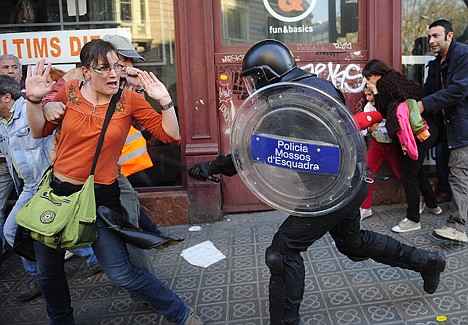
<p>A riot police officer clashes with a demonstrator during the general strike in Barcelona,Thursday. Spanish unions angry over economic reforms are waging a general strike, challenging a conservative government not yet 100 days old and joining other troubled European workers in venting their frustration on the street.</p>
Officials: U.S. missile strike kills 3 in Pakistan
PESHAWAR, Pakistan - A suspected U.S. drone fired two missiles at a house in northwest Pakistan early Friday morning, killing three alleged militants in an attack that comes as Pakistani officials have stepped up their calls for the strikes to end, intelligence officials said.
The attack could complicate U.S. efforts to get Pakistan to reopen its border crossings to supplies meant for NATO troops in Afghanistan. Pakistan shut the border last November in retaliation for American airstrikes that killed 24 Pakistani soldiers.
Pakistan's parliament is debating a revised framework for its relationship with the U.S. that Washington hopes will result in NATO supply routes reopening. But a key demand is that the U.S. stop drone attacks, which are very unpopular in Pakistan because many people believe they mostly kill civilians - a claim denied by the U.S. and contradicted by independent research.
Friday's strike targeted a house in Miran Shah, the main town in the North Waziristan tribal area, a key sanctuary for Taliban and al-Qaida militants, Pakistani intelligence officials said.
The U.S. rarely talks publicly about the covert CIA-run drone program in Pakistan, but officials have said privately that the strikes are a key component of America's war against Islamist militants and have killed senior Taliban and al-Qaida commanders.
Supreme Court votes today on health care case
WASHINGTON - While the rest of us have to wait until June, the justices of the Supreme Court will know the likely outcome of the historic health care case by the time they go home this weekend.
After months of anticipation, thousands of pages of briefs and more than six hours of arguments, the justices will vote on the fate of President Barack Obama's health care overhaul in under an hour Friday morning. They will meet in a wood-paneled conference room on the court's main floor. No one else will be present.
In the weeks after this meeting, individual votes can change. Even who wins can change, as the justices read each other's draft opinions and dissents.
But Friday's vote, which each justice probably will record and many will keep for posterity, will be followed soon after by the assignment of a single justice to write a majority opinion, or in a case this complex, perhaps two or more justices to tackle different issues. That's where the hard work begins, with the clock ticking toward the end of the court's work in early summer.
The late William Rehnquist, who was chief justice for nearly 19 years, has written that the court's conference "is not a bull session in which off-the-cuff reactions are traded." Instead, he said, votes are cast, one by one in order of seniority.
Video raises doubts in Florida gunman's story
MIAMI - Newly released police video of a handcuffed George Zimmerman may be important for what it doesn't show: No obvious cuts, scrapes, blood or bandages. No clearly broken nose. No plainly visible evidence of a life-and-death struggle with Trayvon Martin.
As the furor over race and self-defense raged on in Florida and around the U.S. on Thursday, Martin's family and supporters seized on the footage to dispute Zimmerman's claim that he shot and killed the unarmed black teenager after the young man attacked him.
While cautioning that the video is grainy and far from conclusive, some legal experts agreed it does raise questions about Zimmerman's story. The video was made about a half-hour after the shooting Feb. 26.
Sunni leaders mostly shun Arab League summit
BAGHDAD - Sunni Muslim rulers largely shunned an Arab League summit hosted by Shiite-led Iraq on Thursday, illustrating how powerfully the sectarian split and the rivalry with Iran define Middle Eastern politics in the era of the Arab Spring.
The crisis in Syria is the epicenter of those divisions. The one-day summit closed with a joint call on Syrian President Bashar Assad to stop his bloody crackdown on an uprising seeking his ouster. But the final statement barely papered over the differences among the Arab nations over how to deal with the longest-running regional revolt.
"What disturbs the breeze of our Arab Spring and fills our hearts with sadness is the scenes of slaughter and torture committed by the Syrian regime against our brothers and sisters in Syria," said Mustafa Abdul-Jalil, leader of Libya's National Transitional Council.
In a snub to Iraq, only 10 heads of state from the Arab League's 22 members attended, with the rest sending lower-level officials. Especially notable were the absences of the rulers of Saudi Arabia, Qatar and most other Gulf countries, as well Morocco and Jordan - all of them headed by Sunni monarchs who deeply distrust the close ties between Baghdad's Shiite-dominated government and their top regional rival, Iran.
- The Associated Press