

'If you're different, you stand out'
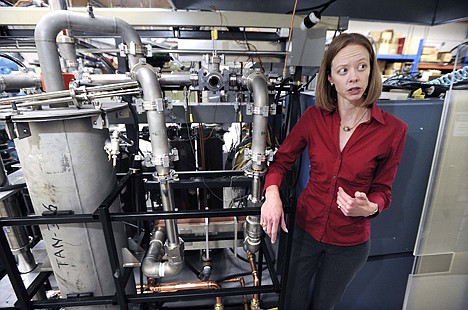
<p>Shannon Bragg-Sitton, a senior nuclear engineer at Idaho National Laboratory, explains a project that tests different types of materials' viable as nuclear fuel cladding in Idaho Falls on Tuesday.</p>
IDAHO FALLS - Women shouldn't let prejudice hold them back in the male-dominated world of science and engineering, say three who ought to know.
As employees in various stages of their careers at Idaho National Laboratory, Mary Dee Grimm, Kathryn McCarthy and Shannon Bragg-Sitton have navigated that world their entire professional lives.
Instead of being a liability, being a woman can have its advantages, they said. Where some men tend to fade into the background, women's exploits tend to catch attention and be remembered, said McCarthy, director of the lab's technical integration office for the Light Water Reactor Sustainability program."If you're different, you stand out, so a lot of times people will remember you; which is good because they'll remember you for other opportunities," McCarthy said. "It can also be bad because if you screw up, they'll remember you then, too."
That's not to say women have an easier path than men.
McCarthy, who's spent 21 years at the lab, said women still face a double standard for behavior, especially in group settings such as meetings and conferences.
"Sometimes, in some situations, a confident, motivated woman is perceived in a negative sense where a man who behaves exactly the same way is not," she said.
In 50 years of working around engineers for the federal government's lab, Mary Dee Grimm has seen women make plenty of strides.
When she first arrived, straight out of high school, it was a rarity to see a woman who held a post any higher than administrative support at the lab. That's changed, as McCarthy can attest, but Grimm admits old perceptions die hard.
"It goes back to, maybe, that women are perceived as more dramatic or more sensitive or more reacting - the emotional side of it," Grimm said. "And Kathy's right. You can see a gentleman kind of get upset or raise his voice, where if a female does, it could be perceived as 'Oh, she's just a little bit emotional today.'"
Bragg-Sitton likes to focus on the benefit of being a woman in a room - or lab space - full of men. She looks at things differently than they do, she said. A fresh point of view can be a contribution in itself when it helps the collective avoid the traps of groupthink, she said.
But ideas aren't enough.
"You also have to have the confidence to speak out and say it," said Bragg-Sitton, who's been at the lab for a year and a half.
Grimm recalled one woman who wasn't afraid to speak her mind. The woman, whose name Grimm didn't share, held a position as assistant to a high-level manager in the late 1960s and early 1970s.
The position itself wasn't a breakthrough for women, but the woman's intelligence and force of personality made her influential, Grimm said.
"We were all scared to death of her, but that's OK," Grimm said. "From that point on it's been a consistent change of more women in higher positions, in different positions."
All three women are mothers, and all three said people close to them have been crucial in allowing them to advance their careers.
McCarthy's husband cut back his working hours when it became clear that her career would take precedence.
Bragg-Sitton's husband quit his job to stay home and care for their children.
Grimm's network of family and close friends gave her the space to keep working in a time when both men and women questioned her place in society.
Bosses, too, have become more accommodating, partly due to self-interest, Bragg-Sitton said.
"You're going to tend to stick with a boss that is supportive of your family decisions and recognizes that family is first," she said.
For all the progress that the lab, specifically, and the professional science and engineering world have made, however, women's place in that world seems to have stalled somewhat, McCarthy said. During the past decade, the percentage of women in academic engineering programs around the country has remained stagnant at less than 20 percent, she said, and no one's sure why.
Women make up less than a quarter of INL's 4,000-person staff. Only 14 percent of the lab's technical positions are occupied by women. But Bragg-Sitton, Grimm and McCarthy agreed that while some institutions are resistant to the arrival of women in positions of authority and influence, they generally have felt welcome at INL.
None of the women regretted pursuing a career. Their decisions may have raised some eyebrows with co-workers, friends and society at large, but they've made for happier families, the women said.