

Urban 'Chinatowns' on the wane
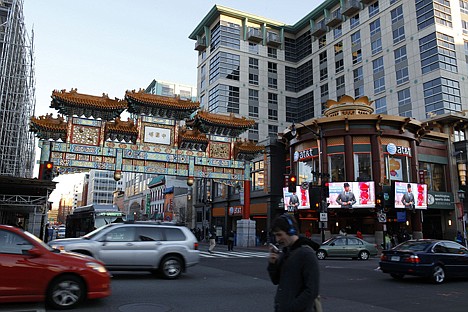
<p>People walk and drive past the "Friendship Arch," a traditional Chinese gate, and an AT&T store in the Chinatown neighborhood of Washington D.C. on Wednesday.</p>
WASHINGTON (AP) - America's historic Chinatowns, home for a century to immigrants seeking social support and refuge from racism, are fading as rising living costs, jobs elsewhere and a desire for wider spaces lure Asian-Americans more than ever to the suburbs.
As the Lunar New Year begins Monday, annual festivities in Washington, D.C.'s shriveled Chinatown are, for the first time, being promoted by a large marketing firm. New York's Chinatown, one of the nation's oldest, has lost its status as home to the city's largest Chinese population, based on the 2010 census.
Shifts also are under way in Los Angeles, Boston, Houston, San Francisco and Seattle, where shiny new "satellite Chinatowns" in the suburbs and outer city limits rival if not overshadow the originals.
"The traditional Chinatown is changing, and in most cities it is no longer the residential, political and cultural center of Asian-American life that it once was," said Wei Li, an Arizona State University professor who chairs the Census Bureau's advisory committee on the Asian population.
She explained that urban Chinatowns continue to serve a role for newly arrived immigrants with less education or lower skills who seek entry-level work, as well as for elderly residents with poor English skills who can't drive. But middle-class families are almost nowhere to be found, and in many cities, rising downtown property costs and urban gentrification threaten their traditional existence.
"Some have become functional as tourist attractions," Li said.
Nationwide, about 62 percent of Asian-Americans in the nation's large metropolitan areas live in the suburbs, up from 54 percent in 1990 and the highest ever. Tied with Hispanics as the fastest-growing group, the nation's 4.4 million Asians are more likely than other minorities to live in the suburbs; only whites, at 78 percent, are higher.
Since 2000, nearly three-fourths of Asian population growth in the U.S. occurred in suburbs, many of them in the South.
"While the general image of Asians is associated with Chinatowns, Koreatowns or urban neighborhoods with Indian restaurants, the majority of all major Asian groups now live in the suburbs," said William H. Frey, a demographer at Brookings Institution, who reviewed the census data. "Suburban living is still the American dream for most minorities in the U.S. and a sign of 'making it,' and better schools are also a draw."
It wasn't always that way.
The first neighborhoods known as Chinatowns emerged in the 1800s during the Gold Rush and the building of railroads. After the work was done, a shortage of jobs led Congress to pass a law in 1882 banning the entry of new Chinese laborers. Seeking refuge, many Chinese in the U.S. avoided jobs that directly competed with white labor and opened laundries and restaurants in urban Chinatowns.
The neighborhoods prospered for much of the 20th century after the ban was lifted, before a loosening of federal immigration laws in 1965. That spurred waves of Asian immigrants in subsequent decades who filled existing Chinatowns and pushed new growth of communities elsewhere.
Today, lower-income immigrant families are now more apt to move to outer city areas in Flushing, Queens, or Sunset Park, Brooklyn, than New York's Chinatown, drawn by affordability and wider spaces.
Online post of beatingpart of nasty trend
CHICAGO (AP) - It seems to defy the logic of committing crimes in a way to avoid getting caught: Ruffians intentionally recording themselves on video beating and robbing someone, then posting it on YouTube so anyone anywhere can see it, including police.
The latest example of this disturbing but increasingly common phenomenon comes from Chicago, where police Wednesday arrested seven teens who apparently did just that. Their video had gone viral and led to their arrest within just days of the Sunday afternoon attack.
"Medieval warriors putting the heads of their enemies on sticks, scalping and even school yard brawls in the '50s - they're all ways of displaying that dominance in public," said Pam Rutledge, a psychologist who heads the Media Psychology Research Center. "These new tools - the Internet, YouTube - just let you spread the word much farther."
Throughout the more than three-minute video, the attackers - many with sweat shirt hoods over their heads and some wearing masks - are seen yelling at the visibly terrified victim, punching and kicking him in the face with apparent glee as he curled up on the snow-covered ground. Police believe the lone girl involved lured the victim to the alley on the city's South Side.