

Amid drought, rare minnows rescued
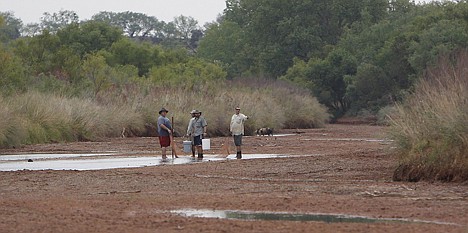
<p>A team of aquatic biologists survey the Double Mountain Fork of the Brazos River as a wild hog runs in the background in a rural area just west of Sagerton, Texas, Friday. The team from Texas Tech and the Texas Parks and Wildlife Department are collecting two species of minnows from the shrinking waters of the West Texas river that has stopped flowing due to the worst drought in decades, therefore, impeding the fish's ability to spawn.</p>
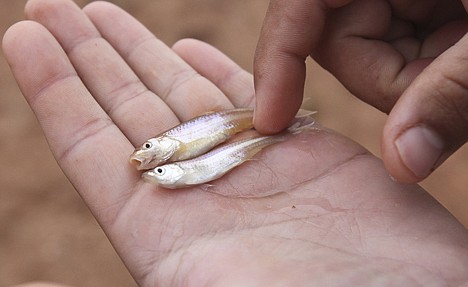
<p>Kevin Kolodziejcyk, with the Texas Parks and Wildlife Department, examines endangered Texas fish smalleye shiner, top, and sharpnose shiner after collecting them from the Double Mountain Fork of the Brazos River in a rural area just west of Sagerton, Texas, Friday.</p>
FORT WORTH, Texas (AP) - Wading through a muddy river bed to reach shallow pools of water, wildlife biologists scooped up hundreds of minnows Friday in one of the first rescues of fish threatened by the state's worst drought in decades.
The scientists collected smalleye shiners and sharpnose shiners from the Brazos River - about 2,300 on Thursday and 800 Friday. The fish, which are found only in the Brazos and nowhere else in the world, are both candidates to be listed as threatened or endangered under the federal Endangered Species Act. They will be taken to the state's fish hatchery near Possum Kingdom Lake but returned to the river when the drought abates.
Scientists used a large net to scoop up dozens of fish at a time Friday morning near Sagerton, about 150 miles west of Fort Worth. Both types of 2-inch-long minnows are shiny and have other distinctive features, making them easy for scientists to spot and put in buckets, while throwing other fish caught in the nets back in the water, said Kevin Mayes, an aquatic biologist with the Texas Parks and Wildlife Department.
With the water drying up in the drought, the minnows don't have the 100 miles of river they need to reproduce. And, their life span is just two years, Mayes said. Game fish like catfish and largemouth bass eat the minnows, making them an important part of the ecosystem, he said.
A team rescued 110 federally threatened Arkansas River shiners and 60 peppered chubs from the Canadian River in the Texas Panhandle near the New Mexico border last week and took them to a federal fish hatchery in Oklahoma. Gene Wilde, a Texas Tech University fish ecology professor who led the team, said he believes that effort was the first fish rescue in Texas during this severe drought.
"We value these species and they are an important part of the Texas natural heritage, so we're trying to prevent losing them in this drought," Wilde said, referring to both rescue efforts.
About 88 percent of the state is in the worst stage of drought, according to the U.S. Drought Monitor map released Thursday. Texas just finished its driest 11 months on record and is in its worst single-year drought ever. It also had the hottest June through August on record in the U.S.