
Teen finds scientific equipment hanging in a tree
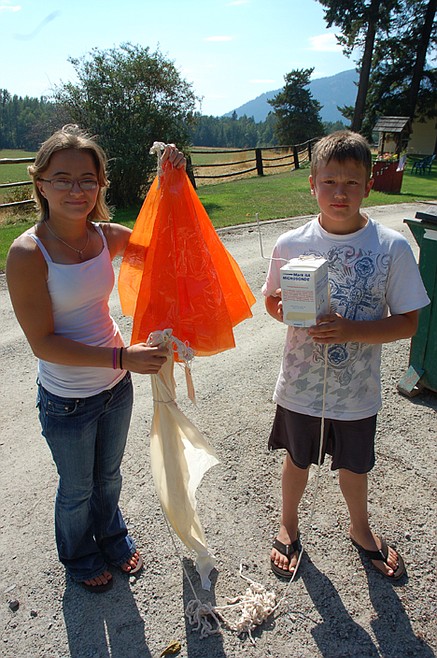
<p>Emily Garman and Drew Hammack display a radiosonde and weather balloon found by their cousin, Jake Steen.</p>
KOOTENAI - If you've ever wondered how the National Weather Service conducts upper-air weather observations, a Bonner County teen's discovery sheds some light.
Jake Steen discovered a rudimentary parachute on his family's property on Aug. 29. Attached to it was a burst latex balloon and a cardboard box with a Styrofoam insert.
"It was hung up in a tree," said Steen.
Inside the Styrofoam enclosure was an expendable weather probe called a radiosonde manufactured by Lockheed Martin. The radiosonde contains sensors which measure profiles of pressure, temperature and relative humidity.
Markings on the box assure the finder that the device is harmless, although a tag affixed to the balloon warn not to disturb it if it's partially inflated because the balloon could be filled with either helium or flammable hydrogen.
Those who encounter radiosondes with inflated balloons are urged to call their local fire department for safe disposal.
The National Oceanic and Atmospheric Administration and the National Weather Service have been using radiospondes since the late 1930s.
The lightweight device is suspended about 80 feet below the balloon, which can ascend at 1,000 feet per minute, according to NOAA. Radiosonde flights can last more than two hours.
They can reach an altitude of 115,000 feet and drift more than 180 miles from their release point. During the flight, the device is exposed to temperatures as cold as 130 degrees below zero and air pressure only a few thousandths of what is found on the Earth's surface.
When the balloon is released, it's about 6 feet in diameter. It expands to up to 25 feet before the balloon ruptures, triggering a plastic parachute to slow its descent in order to prevent it from damaging property or persons below.
On its trip up, sensors on the radiosonde are linked to a battery-powered transmitter that sends measurements to a radio frequency, according to NOAA. The position of the devices is tracked either by GPS or a radio direction-finding antenna.
The data are used for computer-based weather prediction models, storm forecasts, climate change research, air pollution modeling and ground-truthing satellite data.
A label on the box found by Steen indicates the National Weather Service launched the radiosonde on Aug. 25. Included in the Styrofoam container is a postage pre-paid envelope so it can be sent back and used again.
The weather service releases 75,000 radiosondes annually throughout the country, but NOAA said only about 20 percent of them are ever recovered.