
Teri Farr: Rock of the Foundation
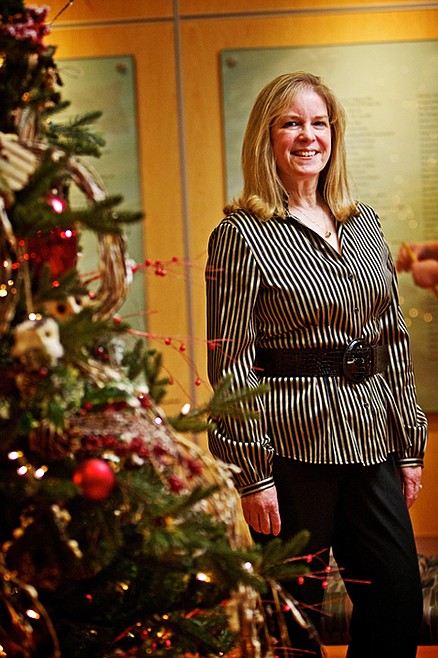
<p>Teri Farr, executive director of the Kootenai Foundation</p>
Kootenai Health is dedicated to providing quality healthcare to all people, regardless of their ability to pay.
One person who helps it achieve that goal is Teri Farr.
Farr is the president of the Kootenai Health Foundation and has been here for 11 years. She oversees the Kootenai Health Foundation, Festival of Trees as well as our communication and marketing department.
As they say, the responsibilities are great. The rewards, greater.
"My favorite days are those when I get to tell the stories about how gifts to the Foundation have impacted people's lives. This year alone we have approved over $600,000 in gifts to Kootenai Health," she wrote. "On one end of the spectrum is a $200,000 piece of equipment that will help speed treatment for lung cancer patients. On the other end we spent $40 to buy shoes for the child of a very low income cancer patient when children at school were teasing him about the holes in his. These are just two examples of the power of giving at Kootenai Health."
How did you become president of the Foundation?
Kootenai Medical Center was recruiting for the position and I was doing the same work at another hospital. I had a strong attraction to this area and the medical center had a great reputation, so I applied and was selected.
Can you share a little about your background?
I grew up moving every 2 to 3 years due to my father's job. After college I started my career in children's protective services. My passion was really around making a difference for abused children. After about 6 years I decided that I wasn't really very good about leaving it behind at the end of the day and I accepted a position as executive director of the first community-based wellness program in the country - as a demonstration project for the Wellness Councils of America.
The wellness field was a welcome and life-changing move for me. Soon after I was hired, though, I learned that continued funding for the program was contingent upon me being able to raise matching funds for our start-up grant.
Thanks to one of my mentors on that board, I learned the art of fundraising from grant writing to major gifts.
Because it was a part-time job when I started, that gave me the flexibility to get my master's degree and start the first CASA program in Wyoming.
Later I was offered a position as the communications director for the hospital. It wasn't long before the hospital decided to replace their outdated patient rooms and we embarked on a major fundraising program to build the new facility. We raised several million dollars for that effort and fundraising became a permanent part of my job.
When I learned about the position search at Kootenai and decided to apply, it was a big move for me. I didn't know anyone here and didn't have any friends or family in the area. So, I came by myself. I think my years growing up and moving helped me to make the transition. It was a very good decision.
Why do you think the Festival of Trees continues to be so successful and such a community attraction?
I think it continues to be successful for a variety of reasons. First, it really is a community event. It takes over 1,000 volunteers to put together the various events, decorate the trees, organize the productions, donate the prizes, sale, and auction items, and then deliver it all to the purchasers. The donors who sponsor do so because they want to be able to count on great medical care and they enjoy being part of something they know will be a success.
We have a strong board and the staff, too, is so committed and has been involved for many years. Bonnie Delyea has been with the Foundation since its beginning in 1983 and Diane Murray was a volunteer for many years before becoming the Festival coordinator 11 years ago. Andrea Johnston joined us 2 years ago and has already become an expert on the program. So, any person in our office can help anyone with any question at any time.
What do you see as your primary role?
I provide strategic direction and oversight for the Foundation's programs. The Festival of Trees is a wonderful community event and annual giving program for us. However, the Foundation also works with donors on many other projects. Each year we select one program as beneficiary of the Festival. I work with the Foundation board of directors and hospital administration to align strategic priorities and select the cause that best aligns with the mission of both organizations. The Foundation supports programs and services that go above and beyond that which the hospital already provides. My role is to find that unique alignment.
Because I am also responsible for strategic oversight of communications at Kootenai Health, we are able to most efficiently and effectively target our energy and communications around priority topics.
One of my most important roles or opportunities is to clearly identify the needs of the medical center and align them with the philanthropic interests of individuals in the community. People really want to make a difference for others, and to do that most effectively, someone needs to facilitate the process. I get to know them and their interests and connect them with the programs and people that fit best.
How do you spend a typical day?
There really isn't a typical day, but every day is about listening to people, finding their passion and helping to find solutions and opportunities.Whether that is with employees, donors, or leadership, everyone has a story and passion to make things better. I see my role as one of connecting passion with purpose.
Typical days are about writing, facilitating, encouraging, listening, coordinating, organizing, budgeting and making decisions. I am constantly looking at the work of Kootenai Health, thinking about it from a community perspective and representing that view.
Could you talk about a few highlights during your career that make this rewarding work?
I love being part of bringing life-changing programs to the community. This year in particular it is rewarding to help raise funds to complete the cardiac service line at Kootenai Health. I had the opportunity to help with the initiation of the Heart Center, so to see it offer the full range of cardiac care will be extremely fulfilling.
I am currently excited to be working on the Child Advocacy Center - a place where children who are being evaluated for abuse can be interviewed and examined in a safe and child-friendly environment.
Are there things you still hope to do as president of the Foundation that you haven't done?
I want to make sure that the Foundation is in excellent shape and hands when I leave. When I hand it over to someone else, I want to be sure that everyone knows the value each employee, each donor and each board member brings individually and that their contributions continue to be respected and stewarded.
What changes have you seen over the years in how the Foundation operates?
The fundamentals are the same - engagement, involvement, stewardship, recognition. What has changed, like in so many other organizations, are the tools we use. We can do a better job because of programs that allow us to keep better records and therefore, be better stewards. At the same time, it also creates greater expectations (mostly of ourselves) to continue to do more.
Is it getting harder to reach out into the community in this economic environment? How do you adapt to these times?
The past few years are a good example of how philanthropy and the economy are so intricately linked. People recognize the needs - perhaps even more so in difficult years, but everyone has fear. Even people with significant assets don't know what might happen tomorrow. So, we just buckle up, ride the roller coaster with everyone else, and continue to move forward. We work harder, tell our story to more people and always try to provide the best possible stewardship of our gifts.
Do you believe the Foundation can continue to serve the community at this high level, despite challenges ahead?
Absolutely. The Foundation's success in supporting healthcare in this community is solely the result of many generous and visionary individuals who are committed to having the highest quality healthcare available close to home when it is needed. When we are seriously sick or injured and feeling our most vulnerable, it is the hospital we look to for the care necessary at that moment.
From the children that host lemonade stands to raise money to help our cancer patients to the generous adults who help fund major hospital equipment, the spirit of giving will continue to grow in our community.
What's ahead for you and the Foundation and Kootenai Health?
Our new CEO at Kootenai Health, Jon Ness, joined us about a year ago now and it has been full steam ahead. In that time we have developed a long-range strategic plan for Kootenai Health. That long-range vision will enable the Foundation to be very proactive in its fundraising efforts. We will be able to plan capital campaigns in advance and engage the community in enhancing services and facilities at Kootenai Health.
What is one thing you would want the community to know about the Foundation and Kootenai Health?
That this really is a unique medical center. There are very few hospitals in this country who are still community owned. Kootenai Health (i.e., Kootenai Hospital District) has its own taxing authority, yet it hasn't used that authority since 1995. Good management and a strong Foundation have been keys to its success.
Looking forward, Kootenai Health anticipates significant reductions in reimbursement. As dollars decrease for capital needs, the hospital will look to the Foundation for increased support. New buildings, equipment and programs will come about because the community values them and wants to support their addition.
Any final thoughts?
Life takes us in interesting directions and you don't always know where you will end up or why. You make the best decisions you can, you take the forks in the road and then you make the most of it. Serendipitously, I moved here without knowing anyone and after being here about a month I discovered that one of my best elementary school friends was living here, Leanne Rousseau, MD. A year later I heard that another friend from that same small school was moving here, Lita Burns. Lita is a nurse and leads the health science programs at NIC, while Leanne is a physician who was instrumental in founding the Dirne Clinic. We were students of Sister Monica Borden (who most influenced my life) and we found her a couple of years ago working at St. Francis Family Center in Spokane. So, I guess my final thought is that you never really know whose life you will impact on a daily basis.