

Dogged disease
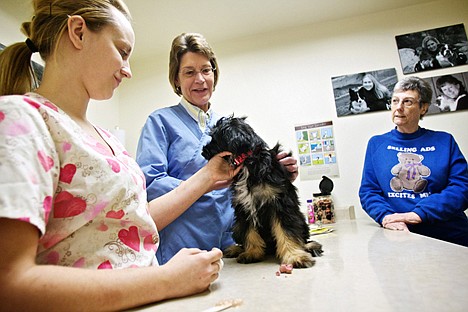
<p>Sharron Barkley watches as her 4-month-old Tibetan Terrier, Tashi,Êis looked over by Megan Leonard, a veterinary technician, left, and Dr. Elesa Anderson after receiving its last Parvo shot Tuesday at Prairie Animal Hospital in Coeur d'Alene.</p>
COEUR d'ALENE - Tashi, all 10 pounds and 5 ounces of him, was almost a perfect patient at Prairie Animal Hospital.
The Tibetan Terrier happily gobbled up a snack, squirming only a bit, as Dr. Elesa Anderson held his black furry coat with one hand and administered the vaccine shot with the other.
For the 4-month-old, this was the final in a series of inoculations that began when she was about eight weeks old to protect her from parvovirus, often fatal for puppies.
"In addition to that, we like to keep the puppies pretty isolated," said Anderson, veterinarian at Prairie Animal Hospital.
Parvo, a viral illness that is considered highly contagious, causes intestinal, respiratory and cardiac problems and dehydration. It can be spread by direct or indirect contact with an infected animal's feces. It can be tracked inside, even on shoes.
"It's a real hardy virus," Anderson said.
Yes it is, said Rondi Renaldo, executive director of the Kootenai Humane Society.
KHS recently received three puppies that were surrendered separately, and later learned each had parvo. Symptoms include weakness, vomiting, fever, and diarrhea.
Two survived and were later adopted out. The third didn't.
Renaldo said it's the first time since she came on board as KHS director last year that they've had animals with the illness.
"It can be very dangerous, especially for puppies," she said. "It's very hard for them to fight that off. If a puppy gets parvo, their immune system is hit very hard."
Renaldo urges anyone with puppies to get the series of shots, which cost around $30, far less expensive than treating parvo later, which can reach more than $1,000.
Once a puppy has parvo, it must be isolated for weeks, and receive IV fluids or more depending on the severity of the disease.
KHS has a special fund, "Hearts of Gold," it used to pay for treating the parvo puppies that cost a total of around $2,000.
Dr. Jim Meyer, another veterinarian at Prairie Animal Hospital, said he hasn't seen a recent outbreak of parvo, but said "it's still really common."
"I haven't felt it was an epidemic-type problem," he said. "It's one we always seem to see quite a bit of."
Meyer said parvo primarily affects puppies that have not been vaccinated. People shouldn't take puppies to dog parks until they've been vaccinated.
"You see it in older age groups," he said. "With us, far and away, the biggest percentage is young puppies."
He said if victims of parvo are "vigorously treated," there is a 70 percent survival rate.
"It could be a devastating disease that will take the puppy down in the first 24 hours of showing symptoms," Meyer said.
Tashi's owner, Sharron Barkley of Coeur d'Alene, isn't about to let that happen.
While Tashi underwent the series of shots, she often carried her when they went out to reduce the chance of the dog contacting parvo.
"I haven't even bothered training her on a leash yet," she said.
"Or why she hasn't taken her yet to the groomer, either," Anderson added.
Tashi, who will grow to about 25 pounds, is in excellent health, Anderson said.
"She's a good little patient," she said.
Barkley, who has two other dogs at home, is happy to have the her puppy protected from parvo.
"I don't have to be worried about taking her out when I start leash training and obedience," she said.