
River levees breeched in northern Missouri
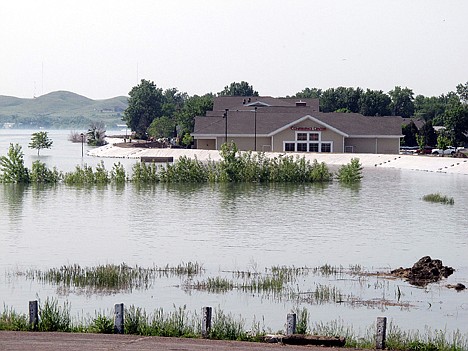
<p>Rising water from the Missouri River laps against the white plastic placed on an emergency levee on June 6 in Fort Pierre, S.D.</p>
KANSAS CITY, Mo. (AP) - Several levees in northern Missouri were failing Sunday to hold back the surge of water being released from upstream dams.
Authorities said water - some of it from recent rain - began pouring over levees Saturday night and Sunday morning in Holt and Atchison counties, flooding farmland and numerous homes and cabins. A hole in the side of a Holt County levee continued to grow Sunday, deluging the state park and recreational area of Big Lake, a community of less than 200 people located 78 miles north of Kansas City.
Jud Kneuvean, chief of emergency management for the corps' Kansas City District, said the Missouri River dipped by almost one foot after the Big Lake breach but that the water level started to rise again by Sunday afternoon.
Meanwhile, the Nebraska Public Power District issued a flooding alert Sunday for its Cooper Nuclear power plant near Brownville, Neb., as the Missouri River continues to rise. The declaration is the least serious of four emergency notifications established by the federal commission.
The plant was operating Sunday at full capacity, and there was no threat to plant employees or to the public, said Mark Becker, a spokesman for the Columbus, Neb.-based utility.
The Fort Calhoun Station, another nuclear plant along the river in eastern Nebraska, issued a similar alert June 6. That plant near Blair, Neb., has been shut down since April and will not be reactivated until the flooding subsides.
The corps said Sunday that the river level at Brownville, Neb., had surged about 2 feet from Saturday morning to Sunday morning. Water was flowing over a levee there and into farmland but the levee was being built up to alleviate that, said Jodi Fawl, spokeswoman for the Nebraska Emergency Management Agency.
In Missouri, presiding Holt County commissioner Mark Sitherwood said U.S. 159 is closed south of Big Lake because water is pouring over the road, and most of the west side of the community is underwater.
"It's going through in one place that we know of and overtopped in numerous places and there is seepage everywhere," Sitherwood said.
He said most people evacuated well in advance of the flooding. Those who stayed were told Saturday night that water was flowing into the area. A few people live in cabins that have been built up and decided to stay, Sitherwood said.
"Everyone up here knows the routine," he said.
Juli and Steve Crenshaw, who were among those Big Lake residents who were remaining and using kayaks to get around, spent Saturday night scrambling to fix leaks in levees around the lake community.
After helping to shore up one levee they headed to another one.
The Big Lake area, where water has been high for the past couple weeks, has experienced major flooding in three of the last five years.
But Sitherwood said this year promises to be much worse following weeks of high flows and increasing releases from the main stem dams in Montana and the Dakotas.