
Science students get an eyeful
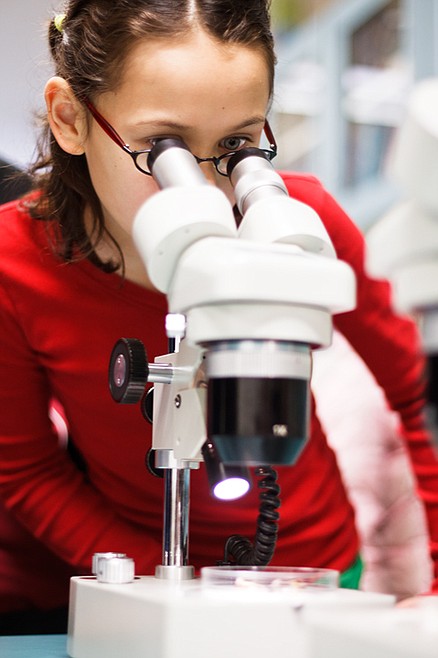
<p>Marie Zaragoza, a fifth-grader at Ramsey Magnet School, peers into a microscope to get a close view of insect specimen Thursday during a science lab opportunity in Lake City High biology class.</p>
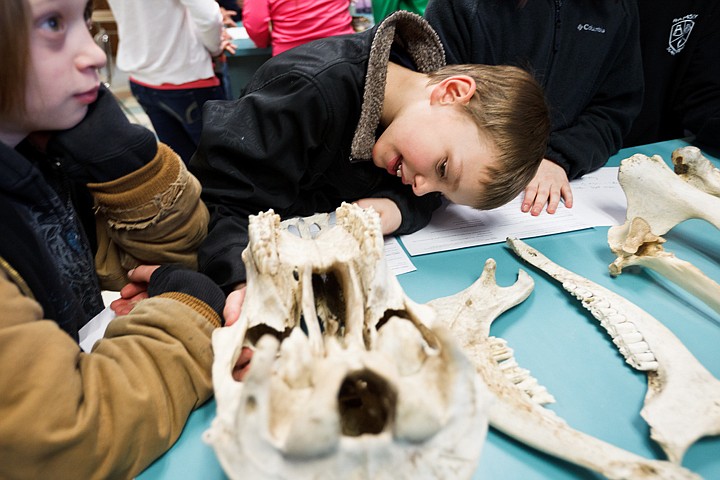
<p>Ramsey Magnet student Dylan Salyer inspects an elk scull during a joint science program at Lake City High.</p>
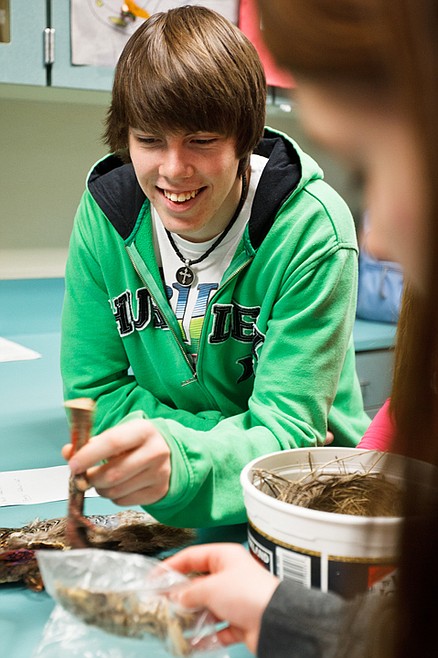
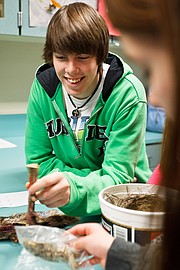
<p>Lake City High School senior Josh Newcomb shows various bird anatomy parts to elementary school students in an animal survey lab.</p>
COEUR d'ALENE - Ray Tekverk turned around and slapped his palm against a sheet of goldenrod-colored paper taped to the white board in front of his classroom.
The Lake City High School science teacher had just dipped his hand in what appeared to be clear water, but Tekverk's smack left behind a wet hand print that was the color of blood.
A group of Ramsey Magnet School fifth-grade students seated at the desks in Tekverk's classroom on Thursday reacted with surprise.
"I did not just shatter all the capillaries in my hand," Tekverk told the young pupils.
Tekverk explained that he had soaked his palm in a baking soda solution. The red result of his slap was a chemical reaction between the baking soda, a base, and the acid in the dye in the goldenrod-colored paper.
The fifth grade students on the receiving end of Tekverk's lesson on acids and bases were among 110 Ramsey Magnet School fifth-graders who visited Lake City High School for a mini-science day.
The fifth-graders circulated through a series of science labs where high school students helped them practice their science skills and taught them a bit of physical science, physics and biology.
In teacher Mike Criswell's International Baccalaureate biology class, high school students gave their young charges a lesson called "Intro to Animals."
The students examined various bits and pieces of different life forms - bones, insects, coral, and more - often under microscopes.
Criswell's high school students freely shared what they have learned with their young pupils.
Adrick Moore, a 16-year-old junior, pointed to a large container holding pig brains floating in a solution.
Moore asked the fifth-graders if they knew why each of the small brains had what appeared to be a "long tail" attached.
"That's the spinal cord. The spinal cord takes directions from the brain and sends them to the rest of the body," Moore said.
Marie Burns, 17, held up a small, segmented object.
"What do you think that is?" Burns asked some fifth-graders who looked perplexed.
Burns shook the object, and smiled, "It's a rattlesnake rattle."
Burns said she enjoyed helping the fifth-graders learn this way, because it shows them what they have to look forward to when they get to high school.
Ramsey teacher Lynda Ehrsam said it's good for the young ones to see the older students get excited about science.
"It encourages them," Ehrsam said. "One of our goals is to help them realize that learning about science doesn't end when they leave the classroom."