
'A blast of the past'
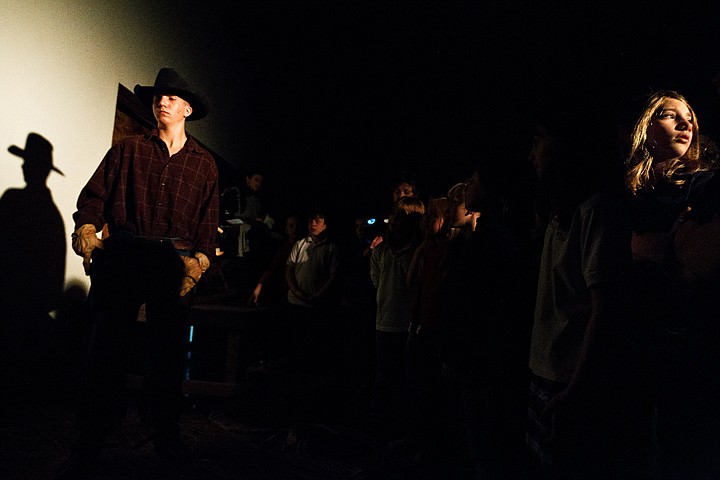
<p>Damian Williams, a sophomore at North Idaho Christian School, left, poses as Elmer Keith, considered the last great American cowboy, as second-grader Julie Haag is illuminated by a spot light Thursday during the World History class wax museum project.</p>
HAYDEN LAKE - Stepping into the gym Thursday at North Idaho Christian School was like entering a time machine.
Like statues, costumed 10th-graders posed motionless, transforming the room into a historical wax museum.
A spotlight moved around the room illuminating students as they portrayed the characters they had selected and researched.
Damian Williams, 16, depicted Elmer Keith, a legendary Idaho rancher and firearms expert. In Western wear, Williams (as Elmer Keith) stood near a campfire, ready to draw a revolver from his side.
"I'm a big outdoorsman myself," Williams said.
Teacher Marilyn Schneiter, acting as museum tour guide, told visitors Keith was born in Missouri, and then moved to Montana with his family. As a child, he was severely burned in a fire.
"The doctor said he would not live to be a young person," Schneiter said.
Keith eventually moved to Salmon, Idaho, where he lived out his life.
Known for his handgun target and hunting shooting, Keith developed the revolver cartridge for the .357 Magnum, and played a role in the development of the .44 and .41 Magnum cartridges.
Williams decided to portray Keith after reading his autobiography.
"It was a very deep book with a lot about the West, and a blast of the past," he said.
John F. Kennedy sat at a desk just inside the door. Across the room, Shirley Temple posed in a polka-dot dress, holding a matching lollipop. Grace Kelly, Queen Isabella, and Johnny Cash were among the host of characters students portrayed.
The Brothers Grimm were depicted by some of their characters, Cinderella and Prince Charming.
Visitors learned that the German brothers not only published scores of folk tales, but also compiled a German dictionary.
Audrey Hepburn stood near a Tiffany & Co. sign as they learned that the famous actress did more than star in "Breakfast at Tiffany's." She was part of the resistance efforts that took place during World War II.
Visitors learned of John Wayne's "True Grit."
"He was a friend of Gary Cooper and Ronald Reagan. They all held strong conservative values," Schneiter said.
The human display was the final piece of a project completed each year in Schneiter's world history class.