

World/Nation Briefs December 24, 2011
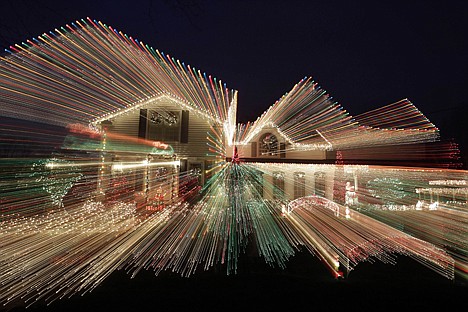
<p>Hundreds of lights illuminate the home of Norm and Michele Rados in Olmsted Township, Ohio, Friday. Rados said it takes four to five weekends of work to finish his annual holiday display leading up to the Sunday after Thanksgiving.</p>
TILTON, N.H. - It's an opening salvo of the presidential campaign, minus actual presidential nominees.
Vice President Joe Biden unleashed a biting critique of Mitt Romney's policies Friday and the Republican came swiftly back at him - a full-contact preview of what the general election might look like should Romney win the GOP nomination to challenge President Barack Obama.
All this, before a vote is cast in the Republican race, The Iowa caucuses, looming Jan. 3, are the first step in the voting to pick a Republican nominee.
In an opinion piece published in The Des Moines Register, Biden portrayed the Republican frontrunner as the purveyor of failed, retreaded economic ideas. Romney shot back that Biden and Obama live an economic "fantasyland" out of touch with the real world.
Biden's jabs mark a major escalation in Obama's re-election campaign and refocus his political team on Romney, the former Massachusetts governor whom Obama advisers have long considered his most likely opponent. And it switches Obama away from his just-concluded tax cut victory over House Republicans to the GOP presidential field just 12 days before the Iowa caucuses.
Poll: Nearly 8 in 10 Americans believe in angels
Angels don't just sing at Christmastime. For most Americans, they're a year-round presence. A new Associated Press-GfK poll shows that 77 percent of adults believe these ethereal beings are real.
Belief is primarily tied to religion, with 88 percent of Christians, 95 percent of evangelical Christians and 94 percent of those who attend weekly religious services of any sort saying they believe in angels.
But belief in angels is fairly widespread even among the less religious. A majority of non-Christians think angels exist, as do more than 4 in 10 of those who never attend religious services.
Beyond the religious gap, women are more likely than men to believe angels are real, and those over 30 are more apt than younger adults to think they exist.
The finding mirrors a 2006 AP-AOL poll, which found 81 percent believed in angels.
Spying programs yielded only mixed results
NEW YORK - When New York undercover officers and informants were infiltrating a mosque in Queens in 2006, they failed to notice the increasingly radical sentiments of a young man who prayed there. Police also kept tabs on a Muslim student group at Queens College, but missed a member's growing anti-Americanism.
Those two men, Najibullah Zazi at the mosque and Adis Medunjanin at the school, would go on to be accused of plotting a subway bombing that officials have called the most serious terrorist threat to the United States since Sept. 11, 2001.
Ever since The Associated Press began revealing New York Police Department spying programs on mosques, student groups, Muslim businesses and communities, those activities have been stoutly defended by police and supporters as having foiled a list of planned attacks.
Recently, for instance, when three members of Congress suggested an inquiry into those programs, Republican Rep. Peter King of New York rallied to the NYPD's defense.
Suicide bombs shake Syrian capital, kill 44
DAMASCUS, Syria - Two car bombers blew themselves up Friday outside the heavily guarded compounds of Syria's intelligence agencies, killing at least 44 people and wounding dozens more in a brazen attack on the powerful security directorates, authorities said.
State-run TV said the al-Qaida terrorist network was possibly to blame for the first suicide car bombings in the nine-month uprising against authoritarian President Bashar Assad.
The opposition, however, immediately questioned the government's account and hinted the regime itself could have been behind the attack, noting it came during a visit by Arab League observers investigating Assad's bloody crackdown of the popular revolt.
The government has long contended that the turmoil in Syria this year is not an uprising but the work of terrorists and foreign-backed armed gangs.
Pakistani army rejects US report on airstrikes
RAWALPINDI, Pakistan - The Pakistani army on Friday rejected key findings from a U.S. investigation into American airstrikes last month that killed 24 Pakistani soldiers and said the report was unlikely to repair the severely damaged relationship between the two countries.
The investigation - details of which were released Thursday - concluded that mistakes on both sides led to last month's deadly attack along the border between Pakistan and Afghanistan. Pakistan has maintained its troops did nothing wrong and the attack was a deliberate act of aggression.
Pakistan refused to participate in the investigation, claiming past U.S. probes into border incidents were biased. It also retaliated against the attack by closing its border to NATO supplies meant for troops in Afghanistan and kicking the U.S. out of a base used to operate American drones.
- The Associated Press