
Montana grizzly story bears similarities
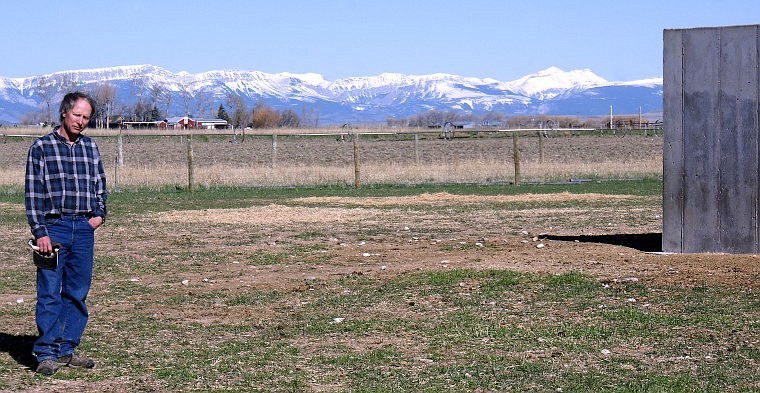
<div><em>Rancher Rick Christy, who lives fifteen miles west of Fairfield, awoke to a disturbing sight on May 10. Two grizzly bears were using his flock of sheep as their breakfast. Christy is standing next to where he shot and killed one of the grizzlies. The pasture is just yards from his house. The two grizzlies kept running on either side of the cement wall (right) so he could never see both bears at once. After he shot the one bear the other finally left. He lost 6 out of 15 sheep in the raid.<br /> Sun Times photo by Cindy Dauwalder</em></div> <p> …
Our friends from the Sun Times in Fairfield, Mont., have shared with us an eerily similar story from this spring. Rick Christy ended up being fined $2,000 for killing a grizzly, according to Sun Times Publisher Darryl Flowers. Flowers also said Christy's father had killed a grizzly years ago, and that the senior Christy's case had gone all the way to the Supreme Court. In June 1989, the senior Christy lost his appeal to the high court. We'll include the dissenting opinion from a member of the Supreme Court at the bottom of this story. Our thanks to Darryl in Fairfield. - Mike Patrick
By CINDY DAUWALDER
Fairfield Sun Times
FAIRFIELD, Mont. — Area Farmer/Rancher Rick Christy, who lives about 15 miles west of Fairfield, was awakened by a phone call in the early morning hours Tuesday, May 10. It was his neighbors calling to let him know they saw bears running around the property and they were attacking something. They thought it might be the dogs at first but upon further investigation Christy realized the bears were killing his sheep.
He saw the first lamb killed in a canal just yards away from his house. As he went along the fence line he noticed a few more sheep lying on the ground and then he met up with two grizzlies who were still chasing down his sheep. They did not even care that he was there. He said at one point they were running parallel with him down the fence line. He had his .308 caliber rifle with him as he watched one of them batting a lamb around before it went in for the kill. There was nothing but a wire fence between him and the grizzlies. He could only see one grizzly at a time because there was a concrete wall that divided the pasture and they were running all over the place. He drew his rifle as he watched the one kill another sheep and took a shot. He thought he hit it in the aorta because it only flopped forward about 23 feet before going down. The other grizzly came around the corner to check things out. It slowly left the property looking behind him as if he was checking to see if his partner was going to follow him.
Christy called the Sheriff's Office right away. The Game Warden out of
Choteau was the first on the scene followed by a Federal Investigator
about an hour later. The Feds reviewed the rifle and returned it to
Christy. They also turned the carcass over to the State. It was used as
bait to trap the remaining bear for possible relocation. Bear traps are
located out on the property where the attacks took place. As of last
Thursday the other bear had not been located.
Christy was told that the bears were probably siblings and the one that was killed was about 3 ½ years old, about 340 pounds and 6 ¼" across the paw. They are unmarked bears that have probably come up from the Sun River.
Christy said he has never killed a bear before, and as a matter of fact,
is not really a hunter at all. He never carries his rifle around the
property. He said, "I just felt like I had to protect my property when
they wouldn't stop killing the sheep." He lost 6 sheep total with 5 of
those being ewes. Two more had survived the attack but were too far gone to save so he had to put them down. His veterinarian helped save a couple of them. He had fifteen on the property. With the market up and down he does not know the actual loss but said it is probably somewhere around $200 a head. He was told that the FWP will submit his loss to the "Defender of Wildlife" program and may receive some compensation. He is, at this point, not sure what type of charges or fines (if any) he will receive for killing the grizzly. State law states it is legal to protect livestock.
* * *
U.S. Supreme Court
CHRISTY v. LUJAN , 490 U.S. 1114 (1989)
490 U.S. 1114
Richard P. CHRISTY, et al., petitioners,
v.
Manuel LUJAN, Jr., Secretary of the Interior and United States Department
of the Interior. No. 88-1461.
Supreme Court of the United States
June 12, 1989
On petition for writ of certiorari to the United States Court of Appeals
for the Ninth Circuit.
The petition for a writ of certiorari is denied.
Justice WHITE, dissenting.
Petitioner Christy is a herder who grazed his sheep on leased land near
Glacier National Park. Between July 1 and July 9, 1982, grizzly bears from
the park killed 20 of Christy's sheep. Requests for assistance from park
rangers yielded no results, and efforts to frighten away the bears were
unsuccessful. On July 9, when two grizzlies emerged from the forest and
approached Christy's sheep, he shot and killed a bear. Grizzlies, however,
are an "endangered species"; Christy's killing of the bear thus violated
the Endangered Species Act, which makes it unlawful to " harass, harm,
pursue, hunt, shoot, wound, kill, trap, capture, or collect" grizzlies and
other animals protected by the statute. 16 U.S.C. [490 U.S. 1114 , 1115]
1538(a)(1), 1532(19). Christy was consequently assessed a $2,500 penalty
for shooting the bear.
Christy then filed this action in District Court, seeking to enjoin
enforcement of the Act against herders like himself, and resisting payment
of the $2,500 penalty. Christy claimed, inter alia, that his actions in
defense of his livestock were protected by the Due Process Clause of the
Fifth Amendment; alternatively, Christy contended that the Act resulted in
an uncompensated "taking" of his property. Both the District Court and the
Ninth Circuit rejected these claims, and this petition ensued.
I would grant the petition for certiorari to consider Christy's
constitutional claims. Christy's claim of a constitutional right to defend
his property is not insubstantial. The right to defend one's property has
long been recognized at common law, see W. Blackstone, Commentaries *
138-140, and is deeply rooted in the legal traditions of this country,
see, e.g., Beard v. United States, 158 U.S. 550, 555 , 15 S. Ct. 962, 963
(1895). Having the freedom to take actions necessary to protect one's
property may well be a liberty "deeply rooted in this Nation's history and
tradition," Moore v. East Cleveland, 431 U.S. 494, 503 , 1938 (1977)
(opinion of Powell, J .), and, therefore, entitled to the substantive
protection of the Due Process Clause. In any event, Christy's claim to
such protection presents an interesting and important question-the proper
resolution of which is not altogether clear-that merits plenary review.
Even more substantial is Christy's claim that the Endangered Species Act
operates as a governmental authorization of a "taking" of his property ;
leaving him uncompensated for this taking violates the Fifth Amendment,
Christy contends. There can be little doubt that if a federal statute
authorized park rangers to come around at night and take Christy's
livestock to feed the bears, such a governmental action would constituted
a "taking." The Court of Appeals below, and the federal parties in their
submission here, distinguish such a case from this one, by noting that the
United States "does not 'own' the wild animals it protects, nor does the
government control the conduct of such animals." Christy v. Hodel, 857 F.
2d 1324, 1335 (CA9 1988); see Brief of the Respondents in Opposition.
Perhaps not; but the Government does make it unlawful for Christy to "
harass, harm, [or] pursue" such animals when they come to take his
property-and perhaps a Government edict bar- [490 U.S. 1114 , 1116] ring
one from resisting the loss of one's property is the constitutional
equivalent of an edict taking such property in the first place. Thus, if
the Government decided (in lieu of the food stamp program) to enact a law
barring grocery store owners from "harassing, harming, or pursuing" people
who wish to take food off grocery shelves without paying for it, such a
law might well be suspect under the Fifth Amendment. For similar reasons,
the Endangered Species Act may be suspect as applied in Christy's case.
In sum, sustaining grizzly bears is a worthwhile and important
governmental objective. But it "is axiomatic that the Fifth Amendment's
just compensation provision is 'designed to bar Government from forcing
some people alone to bear public burdens which, in all fairness and
justice, should be borne by the public as a whole.' " First English
Evangelical Lutheran Church of Glendale v. County of Los Angeles, 482 U.S.
304 , 318-319, 2387-2388 (1987) (quoting Armstrong v. United States, 364
U.S. 40, 49 , 1569d 1554 (1960)). Here, Christy has been asked to bear the
burden of feeding endangered grizzlies-or at the least, has been estopped
from taking measures necessary to prevent the use of his property for this
purpose. Thus, it seems quite possible that Christy has been denied the
Fifth Amendment's protection against uncompensated takings.
Because I think that Christy's constitutional claims present interesting
and important questions that merit our attention, I dissent from the
Court's denial of review in this case.