

Brutal Texas drought slams ecosystems
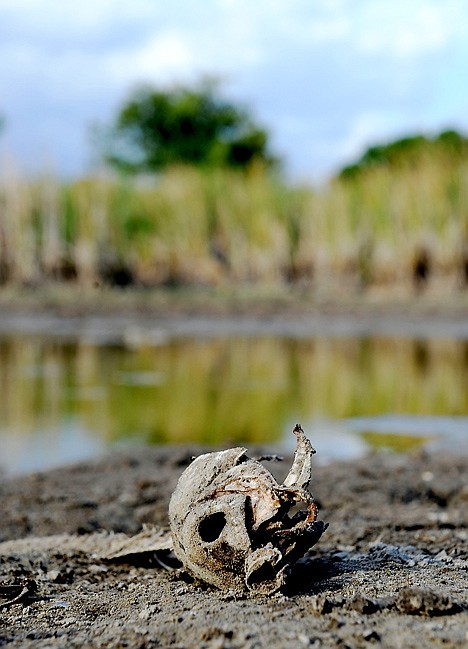
<p>A skeletons of dead fish lay on the ground of a nearly dried up pond at the Gene Howe Wildlife Management Area on Aug. 2, 2011 in Amarillo, Texas. A devastating drought sweeping across Texas is turning rivers into sand, creeks into mud, springs into mere trickles and lakes into large puddles, destroying habitats and ecosystems crucial to the survival of hundreds of wildlife and plant species. Now, with the second-worst drought in Lone Star State history expected to stick around for at least a year, biologists say the impacts on those habitats will be so severe and widespread they wil…
CANADIAN, Texas (AP) - In a muddy pile of sand where a pond once flowed in the Texas Panhandle, dead fish, their flesh decayed and feasted on by maggots, lie with their mouths open.
Nearby, deer munch on the equivalent of vegetative junk food and wild turkeys nibble on red harvester ants - certainly not their first choice for lunch.
As the state struggles with the worst one-year drought in its history, entire ecosystems, from the smallest insects to the largest predators, are struggling for survival. The foundations of their habitats - rivers, springs, creeks, streams and lakes - have turned into dry sand, wet mud, trickling springs or, in the best cases, large puddles.
"It has a compound effect on a multitude of species and organisms and habitat types because of the way that it's chained and linked together," said Jeff Bonner, a wildlife biologist with the Texas Parks and Wildlife Department.
Since January, Texas has gotten about 6 inches of rain, compared with a norm of about 13 inches, making it the most severe one-year drought on record.
The extreme dry conditions, which have extended into parts of the Plains, including Oklahoma and Kansas, have been made worse by week after week of triple-digit temperatures that have caused reservoirs to evaporate, crops to wither and animals and fish to die.
Some rivers and lakes are at lows not seen since the 1950s, the decade when Texas had its worst drought in recorded history.
In some cases, bodies of water are at their lowest points ever, said Joseph Capesius, chief of the Austin field unit for the U.S. Geological Survey.
At least seven reservoirs effectively are empty, and more than half of the streams and rivers are at below-normal flow rates.
In West Texas, O.C. Fisher Lake has been so depleted that fish have died from a lack of oxygen and bacteria has turned the remaining water red.
Without plants, there are fewer insects. No insects means low seed production. The animals that rely on seeds and plants for nutrition reproduce less. Predators that rely on those animals as a food source remain hungry as well, and they reproduce less.